
Card Game: A Complete Guide to Popular Games, Rules, Skills, and Entertainment
Introduction
A card game can be simple enough for a beginner to learn in minutes yet interesting enough to keep experienced players engaged for years. From traditional family games to competitive strategy games, cards have become a familiar form of entertainment across cultures and generations.
What makes card games especially appealing is their versatility. Some games depend mainly on luck, while others reward memory, planning, observation, probability, and decision-making. They can be played casually with friends, competitively in organized settings, or simply as a relaxing activity at home.
This guide explores the world of card games, explains how they work, discusses popular categories, and offers useful tips for choosing and learning a game.
What Is a Card Game?
A card game is an activity that uses playing cards as the main components of gameplay. The objective, rules, number of players, and required skills depend on the particular game.
Some games use a traditional 52-card deck, while others use specially designed cards with unique symbols, characters, instructions, or abilities.
Card games can generally be divided into several broad categories, including:
- Strategy games
- Trick-taking games
- Matching games
- Shedding games
- Collectible card games
- Casino-style games
- Party card games
- Educational card games
- Solitaire-style games
Each category provides a different type of experience.
A Brief History of Card Games
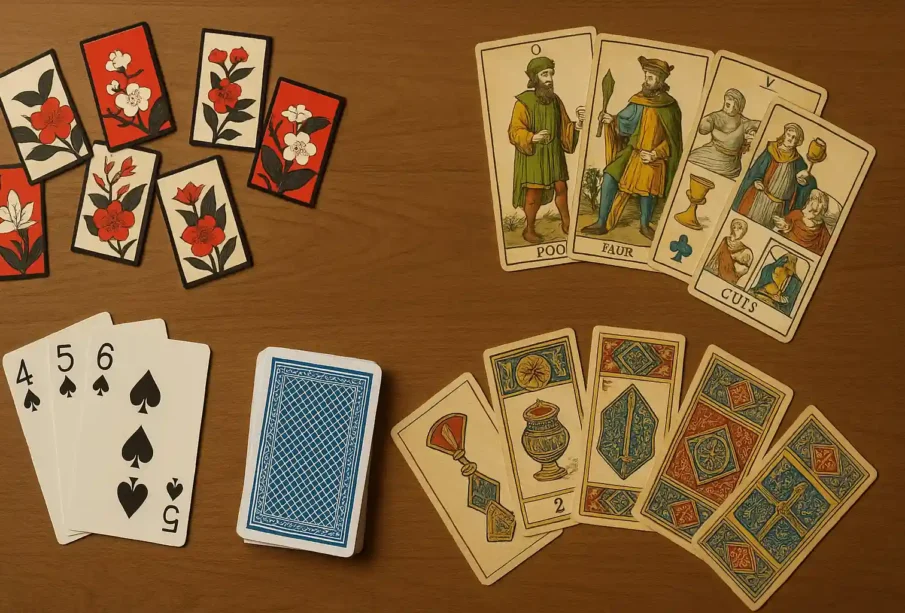
Playing cards have a long history, with early forms appearing in Asia before spreading to other parts of the world. Over centuries, different regions developed their own card designs, suits, rules, and traditions.
European playing cards eventually became standardized around familiar suits such as hearts, diamonds, clubs, and spades. The basic 52-card deck later became widely recognized as a versatile tool for countless games.
Today, traditional cards coexist with modern specialty decks and digital card games. Mobile devices and computers have also introduced classic card games to new audiences.
Understanding a Standard Deck
A standard playing-card deck usually contains 52 cards divided into four suits.
Hearts
Hearts are traditionally represented by a red heart symbol.
Diamonds
Diamonds are another red suit and are represented by a diamond-shaped symbol.
Clubs
Clubs are traditionally black and represented by a three-lobed symbol.
Spades
Spades are black and use a pointed spade symbol.
Each suit normally contains 13 ranks:
- Ace
- 2 through 10
- Jack
- Queen
- King
Some games use additional cards such as jokers, while others remove certain cards depending on their rules.
Popular Types of Card Games
There is no single way to play with cards. Different game types appeal to different interests.
Trick-Taking Games
In trick-taking games, players compete to win individual rounds known as tricks.
Players typically play one card per turn, and the strongest qualifying card wins the trick according to the game’s rules.
Examples include traditional games such as bridge, hearts, spades, and many regional variations.
Matching Games
Matching games require players to identify cards that share a number, symbol, color, or other characteristic.
These games are often easy to introduce to children and beginners.
Shedding Games
The objective of a shedding game is generally to get rid of all your cards before the other players.
Players may need to match a color, number, symbol, or previously played card depending on the rules.
Solitaire Games
Solitaire is usually played by one person. The cards are arranged according to a specific layout, and the player attempts to reorganize them according to predetermined rules.
Because it can be played alone, solitaire remains a popular choice for quiet entertainment.
Strategy Card Games
Strategy-focused card games require players to make decisions based on available cards, possible outcomes, and the actions of opponents.
Success may depend on planning several moves ahead rather than simply waiting for favorable cards.
Collectible Card Games
Collectible card games use specialized decks in which players can acquire, customize, and combine cards.
Different cards may have unique abilities, strengths, weaknesses, or strategic functions.
These games can create a deeper experience for players who enjoy customization and long-term strategy.
Why Are Card Games So Popular?
Easy to Carry
A deck of cards takes very little space, making it convenient for travel, gatherings, and family activities.
Flexible Player Counts
Some games are designed for two players, while others can accommodate larger groups.
Affordable Entertainment
A standard deck can support numerous games without requiring specialized equipment.
Different Skill Levels
There are card games for young children, casual players, serious competitors, and almost everyone in between.
Social Interaction
Many card games encourage conversation, friendly competition, cooperation, and shared experiences.
Skills Card Games Can Encourage
Card games can provide more than entertainment. Depending on the game, they may encourage several useful skills.
Strategic Thinking
Players often need to evaluate options and choose the most promising move.
Memory
Some games require remembering previously played cards or tracking information.
Probability Awareness
Players may naturally begin considering which outcomes are more or less likely.
Decision-Making
Many games force players to make choices with incomplete information.
Concentration
Following a game requires attention to the cards, rules, and actions of other players.
Example: A Simple Two-Player Card Game
Consider a basic high-card game.
- Shuffle a standard deck.
- Divide the cards between two players.
- Each player places one card face up.
- The player with the higher card wins the round.
- Continue until the agreed number of rounds is completed.
This simple example demonstrates how a card game can be created using only a deck, a few rules, and a clear winning condition.
More advanced games build considerably more complexity on these basic ideas.
How to Choose the Right Card Game
The best card game depends on the people playing and the type of experience they want.
For Beginners
Choose a game with short rules and limited setup.
For Families
Look for games that support different ages and do not require extensive reading or complicated calculations.
For Strategy Fans
Choose games that reward planning, probability, resource management, or tactical decisions.
For Large Groups
Party-style games or games designed for several players may work better than traditional two-player formats.
For Solo Players
Solitaire-style games are an obvious option because they do not require an opponent.
Tips for Learning a New Card Game
Read the Objective First
Before memorizing every rule, understand what players are trying to accomplish.
Learn the Turn Structure
Knowing what happens during each player’s turn makes the rest of the rules easier to understand.
Start With a Practice Round
A practice game allows players to learn naturally without worrying too much about winning.
Keep Rules Available
For unfamiliar games, having the instructions nearby can prevent disagreements and confusion.
Don’t Try to Master Everything Immediately
Many card games contain advanced strategies that become easier to understand after several rounds.
Common Mistakes When Learning Card Games
Ignoring the Winning Condition
Players sometimes focus so heavily on individual moves that they forget the overall objective.
Forgetting Turn Order
Incorrect turn order can change the outcome of a game.
Misunderstanding Special Cards
Some games use cards with unique effects. These should be explained before starting.
Changing Rules Mid-Game
House rules can be fun, but everyone should agree on them before the game begins.
Taking Friendly Games Too Seriously
Competition can make games exciting, but the main purpose of casual play is usually enjoyment and social interaction.
Card Games for Children
Card games can be adapted for younger players by using simpler rules and colorful cards.
Simple matching activities can help children practice recognition and memory. Number-based games can introduce basic counting and comparison.
Parents and teachers can also create educational card games focused on:
- Vocabulary
- Mathematics
- Colors
- Shapes
- Spelling
- General knowledge
The key is to match the complexity of the game to the child’s age and abilities.
Card Games for Social Gatherings
A good card game can make a casual gathering more interactive.
For a small group, a quick competitive game may work well. For a larger party, a game with simple rules and short rounds may be easier to manage.
When selecting a game for a gathering, consider:
- Number of players
- Average round length
- Age range
- Difficulty level
- Available space
- Interest of the group
A game that fits the group is usually more enjoyable than simply choosing the most popular title.
Traditional vs. Digital Card Games
Technology has transformed how people play cards.
Traditional Card Games
Physical cards provide a face-to-face experience. Players shuffle, deal, hold, and organize their own cards.
Digital Card Games
Digital versions can automate dealing, scoring, rules, and calculations. They may also allow players to compete against computer-controlled opponents or people in different locations.
Both formats have advantages. Physical games emphasize social interaction, while digital versions offer convenience and automated gameplay.
Are Card Games Based on Luck or Skill?
The answer depends on the specific game.
Some card games are heavily influenced by chance because players cannot control which cards they receive.
Others reward strategic thinking, memory, probability assessment, and long-term planning.
Many popular games combine both elements. Luck determines the cards available, while player decisions determine how those cards are used.
Frequently Asked Questions
What is the most common type of card game?
There is no single worldwide answer because different cultures and regions favor different games. Trick-taking, matching, shedding, strategy, and solitaire games are all widely represented.
How many people can play a card game?
It depends on the rules. Some games are designed specifically for two players, while others can accommodate large groups.
Can card games be educational?
Yes. Card games can be designed to practice mathematics, vocabulary, memory, spelling, and other subjects.
Are card games good for families?
Many card games are suitable for families, especially those with simple rules and flexible difficulty levels.
Can I create my own card game?
Absolutely. Start with a clear objective, define the cards players need, establish turn rules, and decide how a player wins. Test the game with friends and adjust rules that cause confusion.
What makes a card game enjoyable?
Good card games usually have clear rules, meaningful choices, an appropriate level of challenge, and a pace that keeps players engaged.
Are digital card games different from traditional games?
The basic concepts can be similar, but digital versions can automate dealing, scoring, animations, and rule enforcement.
Can card games improve strategic thinking?
Some card games encourage planning, probability assessment, memory, and decision-making. The effect depends on the design and complexity of the particular game.
Conclusion
Card games offer a remarkably broad form of entertainment. A single deck can provide simple family activities, competitive challenges, educational exercises, and strategic experiences.
The best game depends on the players, their experience level, the size of the group, and the type of entertainment they prefer. Beginners can start with simple rules and gradually explore more complex formats as their confidence grows.
Whether played around a table with friends, used as a learning activity, or enjoyed digitally, card games continue to adapt while retaining the qualities that made them popular in the first place: simplicity, interaction, competition, and the excitement of discovering what comes next.