Blackjack: A Complete Guide to the Rules, Strategy, and Basics for Beginners
Introduction
Blackjack is one of the most recognizable card games in the world. Known for its simple objective, quick rounds, and combination of decision-making and chance, the game attracts both beginners and experienced players. Unlike some casino games where players simply wait for an outcome, blackjack gives players choices during each hand.
The basic goal is straightforward: build a hand with a value closer to 21 than the dealer’s hand without going over 21. Players must decide whether to take another card, stay with their current hand, or use other options depending on the rules of the table.
Although the basic rules are easy to learn, understanding card values, betting options, dealer rules, and common strategies can make the game much easier to follow.
What Is Blackjack?
Blackjack is a card game traditionally played between players and a dealer. The game is usually played with one or more standard decks of playing cards.
Each player receives cards, and the dealer also receives cards. Players then try to create the strongest possible hand without exceeding 21.
A hand with a value greater than 21 is called a bust and normally loses immediately.
The game is sometimes called 21 because reaching a total of 21 is central to its objective.
Understanding Blackjack Card Values
Knowing how cards are valued is the first step for any new player.
Number Cards
Cards from 2 through 10 are worth their printed values.
For example:
- A 4 is worth 4 points.
- A 7 is worth 7 points.
- A 10 is worth 10 points.
Face Cards
Jacks, queens, and kings are each worth 10 points.
The Ace
The ace is unique because it can be worth either 1 or 11, depending on which value benefits the hand without causing a bust.
For example, an ace and a 7 can have a value of 18 because the ace can count as 11.
If another card makes 11 impossible without exceeding 21, the ace can count as 1 instead.
The Objective of Blackjack
The goal is not simply to reach exactly 21 every time.
Instead, you generally want your hand to have a higher value than the dealer’s hand without going over 21.
For example:
- Player: 19
- Dealer: 17
The player wins because 19 is closer to 21.
However:
- Player: 22
- Dealer: 18
The player loses because the player’s hand exceeded 21.
If the player and dealer have the same final value, the result is generally a push, meaning the original wager is returned under standard rules.
How a Blackjack Round Works
A typical round follows several basic stages.
1. Place a Bet
Before the cards are dealt, players place their wagers according to the table’s rules and limits.
2. Receive the Initial Cards
The player and dealer receive their starting cards. In many common formats, the player receives two visible cards while the dealer has one visible card and one hidden card.
3. Check the Initial Hand
The player adds the values of the first two cards.
If the starting hand is an ace together with a 10-value card, it is generally called a natural blackjack.
4. Make a Decision
Depending on the hand and table rules, the player may have several options.
Common choices include:
- Hit
- Stand
- Double down
- Split
5. Dealer Plays
After players complete their hands, the dealer reveals the hidden card and follows predetermined rules for drawing or standing.
6. Compare Hands
The player’s final hand is compared with the dealer’s hand to determine the outcome.
Common Blackjack Actions
Understanding the available actions is essential for beginners.
Hit
Choosing to hit means asking for another card.
For example, if your hand totals 12 and you believe another card could improve your position, you may choose to hit.
However, taking another card also creates a risk of going over 21.
Stand
Standing means keeping your current hand and taking no additional cards.
For example, if you have 19, you may decide that taking another card creates too much risk.
Double Down
Doubling down generally means doubling your original wager in exchange for receiving one additional card, after which you must stand.
Rules regarding when doubling is permitted vary between tables.
Split
If your first two cards have the same value under the applicable rules, you may sometimes split them into two separate hands.
Each new hand receives an additional card, and a separate wager is generally required.
Because splitting creates additional exposure, players should understand the specific table rules before using this option.
What Is a Blackjack?
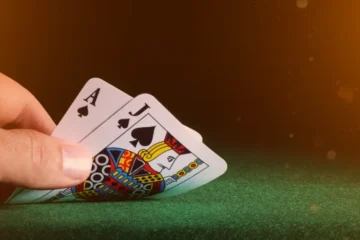
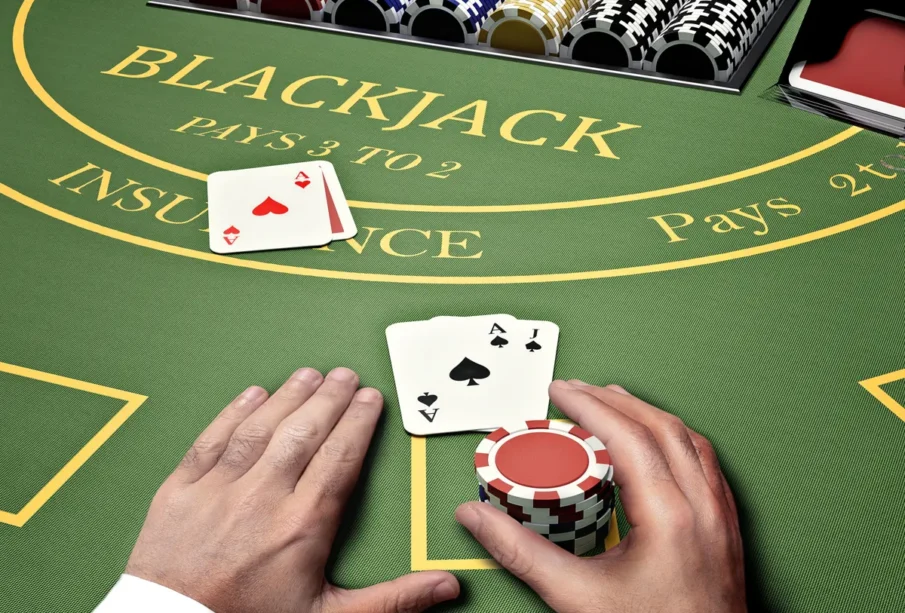
A natural blackjack normally consists of an ace and a 10-value card as the initial two cards.
For example:
- Ace + King
- Ace + Queen
- Ace + Jack
- Ace + 10
This is different from simply reaching 21 with three or more cards.
For instance, a hand consisting of 7, 7, and 7 totals 21 but is not generally considered a natural blackjack.
The payout for a natural blackjack depends on the rules of the particular game.
What Happens When You Bust?
A bust occurs when the value of your hand exceeds 21.
For example:
A player has 16 and receives a 9.
16 + 9 = 25.
The player has busted and normally loses the hand immediately, regardless of what the dealer eventually receives.
This is why deciding when to take another card is one of the central decisions in blackjack.
Blackjack Example
Imagine you receive:
- 10
- 6
Your total is 16.
The dealer’s visible card is a 6.
You must decide whether to hit or stand.
If you hit and receive a 4, your total becomes 20. You would then normally stand.
If instead you received a 7, your total would become 23 and you would bust.
This example shows why blackjack involves both opportunity and risk. The same decision can produce very different results because the next card is uncertain.
Basic Blackjack Strategy
Blackjack strategy is different from simply guessing what card will appear next.
Players can use established mathematical strategies based on their own hand and the dealer’s visible card. These strategies are designed to reduce the house advantage under particular rules.
Consider the Dealer’s Visible Card
The dealer’s exposed card provides important information.
For example, some dealer upcards are generally considered stronger than others because they can lead to stronger final hands more frequently.
Players often use the dealer’s visible card together with their own total when deciding whether to hit, stand, double, or split.
Avoid Decisions Based Only on Emotion
A previous loss does not mean that the next hand is “due” to win. Likewise, winning several hands does not guarantee that another win will follow.
Each hand should be treated as a new situation.
Learn Basic Strategy
A basic strategy chart provides recommended decisions based on the player’s cards and dealer’s upcard under specific rules.
It does not guarantee winning. Instead, it provides mathematically informed decisions intended to minimize unnecessary disadvantage.
Understanding Soft and Hard Hands
These terms can initially sound complicated, but they are easy to understand.
Soft Hand
A soft hand contains an ace that can currently be counted as 11 without exceeding 21.
For example:
Ace + 6 = 17.
This is called a soft 17 because the ace can potentially change from 11 to 1 if another card makes that necessary.
Hard Hand
A hard hand either contains no ace or contains an ace that must count as 1 to keep the total at 21 or below.
For example:
10 + 6 = 16.
Another example is:
Ace + 6 + 10 = 17.
In the second example, the ace must count as 1 because counting it as 11 would produce a total above 21.
Blackjack and Probability
Blackjack involves probability because players do not know which card will be dealt next.
The composition of the deck, number of decks, dealer rules, payout rules, and player decisions can all influence the mathematical house edge.
This is one reason blackjack strategy should not be separated from the specific rules of the game being played.
A strategy that is appropriate for one set of rules may not be optimal for another.
Common Blackjack Mistakes
Treating Every 17 the Same
A soft 17 and hard 17 are not necessarily strategically identical.
The presence of an ace can change the available possibilities.
Chasing Losses
Increasing bets simply because previous hands were unsuccessful can lead to unnecessary financial risk.
Assuming Patterns Predict Future Cards
Random card outcomes do not follow a predictable cycle. A particular card appearing several times does not automatically mean another card is “due.”
Ignoring Table Rules
Payouts, dealer actions, doubling restrictions, splitting rules, and other conditions can vary.
Always understand the rules before committing money to a game.
Playing Blackjack Responsibly
When blackjack is played for money, responsible decision-making is important.
Set a spending limit before playing and treat the money as entertainment spending rather than expected income. Avoid using money needed for essential expenses.
Players should also avoid chasing losses. Losing money does not create an obligation to continue playing until it is recovered.
For people who find gambling difficult to control, avoiding gambling altogether is the safest choice.
Blackjack at Home
Blackjack does not have to involve gambling.
Friends and family can play using chips with no monetary value. This allows everyone to practice the rules and enjoy the competitive element without financial risk.
A home game can also be customized with different rules, practice rounds, and rotating dealers.
For beginners, this can be a comfortable way to learn card values and actions before playing in a formal setting.
Frequently Asked Questions About Blackjack
Is blackjack difficult to learn?
No. The basic rules can be learned quickly. The more challenging part is understanding strategy and how different table rules affect decisions.
Why is blackjack called 21?
The name comes from the game’s central objective of creating a hand that approaches or reaches 21 without exceeding it.
What is the best starting hand in blackjack?
A natural blackjack is generally the strongest possible initial hand because it consists of an ace and a 10-value card.
Can the dealer bust?
Yes. The dealer can exceed 21 just like a player. If the player has not already busted and the dealer busts, the player generally wins.
What happens when the player and dealer have the same total?
In a standard game, an equal final total is generally a push. The player’s original wager is returned.
Is blackjack a game of skill or luck?
It contains both elements. The cards are determined by chance, while player decisions can influence the mathematical quality of those choices. Strategy cannot guarantee a win.
Does basic strategy guarantee profit?
No. Basic strategy can help reduce the mathematical disadvantage under specific rules, but individual sessions can still result in losses.
Can blackjack be played without money?
Yes. It can be played recreationally with chips that have no cash value.
Conclusion
Blackjack is popular because it combines simple rules with meaningful player decisions. Learning the value of each card, understanding actions such as hit and stand, and recognizing concepts such as soft and hard hands provides a strong foundation for beginners.
Strategy can help players make more informed decisions, but it cannot eliminate chance or guarantee a profit. Table rules also matter, so understanding the specific conditions of a game is just as important as learning general blackjack principles.
Whether played casually with friends or studied as a traditional card game, blackjack offers an engaging combination of probability, decision-making, and suspense. For anyone learning the game, the best starting point is to understand the rules thoroughly, practice without financial pressure, and approach money-based play responsibly.