Blackjack: Understanding the Game, Smart Play, and Essential Rules for New Players
Introduction
Blackjack has remained a popular card game because it is easy to understand while still giving players meaningful choices. The central goal is simple: build a hand that beats the dealer’s hand without allowing the total to go above 21.
For someone new to blackjack, the different terms and decisions can initially feel overwhelming. Card values, dealer rules, natural blackjack, hitting, standing, splitting, and doubling are all important parts of the game. Once these basics are understood, a beginner can follow a typical round with confidence.
This guide explores the fundamentals of blackjack, common gameplay situations, basic strategic ideas, and responsible ways to enjoy the game.
What Makes Blackjack Different?
Many traditional casino-style games are based almost entirely on waiting for a result. Blackjack is different because the player makes decisions after receiving cards.
A player may need to decide whether to:
- Take another card
- Keep the current hand
- Increase the wager and take one card
- Divide a qualifying starting hand into two hands
These choices do not remove the element of chance, but they make blackjack more interactive.
Understanding the Number 21
The number 21 is at the heart of the game.
A player generally wants the highest possible total that does not exceed 21. If the total goes above 21, the hand busts.
For example:
18 is a valid hand.
21 is an even stronger valid hand.
23 is a bust.
However, getting exactly 21 is not always necessary. If a player has 19 and the dealer has 17, the player wins even though neither hand reached 21.
Blackjack Card Values Explained
Cards from 2 to 10
Number cards have their printed value.
A 2 is worth two points, a 5 is worth five points, and a 10 is worth ten points.
Face Cards
Jacks, queens, and kings are worth 10 points each.
This means:
Jack = 10
Queen = 10
King = 10
The Flexible Ace
The ace can be worth either 1 or 11.
This flexible value is one of the most interesting features of blackjack.
For example:
Ace + 7 = 18
The ace counts as 11 in this situation.
But consider:
Ace + 7 + 9
If the ace counted as 11, the total would be 27. Therefore, the ace counts as 1, producing a total of 17.
How a Standard Round Begins
A typical blackjack round starts with players placing their wagers.
The dealer then distributes the initial cards according to the rules of the table.
Players usually receive two cards, while the dealer also receives two cards. One dealer card is generally visible and the other may remain hidden until the player decisions are completed.
The visible dealer card is often called the dealer’s upcard.
What Should a Player Do After Receiving Cards?
Once the starting cards are dealt, the player evaluates the hand and decides which action is appropriate.
Hit
A hit means taking another card.
This can be useful when the current total is relatively low and there is an opportunity to improve the hand.
Stand
Standing means keeping the current total and ending the player’s turn.
A player may choose to stand when the hand is strong enough or when another card carries an unacceptable risk of busting.
Double Down
Double down generally allows the player to increase the original wager and receive one additional card.
After receiving that card, the player normally has to stand.
The availability and conditions of doubling vary between games.
Split
If the first two cards meet the table’s requirements, a player may be allowed to split them into two separate hands.
A second wager is generally required.
Each resulting hand is then played separately.
What Happens After the Player Acts?
Once the player has completed the available actions, the dealer plays according to fixed rules.
Unlike the player, the dealer generally does not freely choose whether to hit or stand based on personal judgment. The dealer follows predetermined requirements specified by the game.
After the dealer completes the hand, the final totals are compared.
Understanding a Natural Blackjack
A natural blackjack normally consists of two cards:
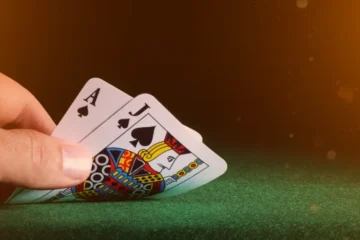
An ace + a 10-value card
Examples include:
- Ace and 10
- Ace and jack
- Ace and queen
- Ace and king
This is usually treated differently from a total of 21 created using three or more cards.
For example:
7 + 7 + 7 = 21
Although the total is 21, it is not normally called a natural blackjack.
What Is a Push?
A push occurs when the player and dealer finish with the same total, assuming neither has a special qualifying blackjack result.
For example:
Player: 18
Dealer: 18
The result is generally a tie, and the original wager is returned.
Specific rules can differ, so players should check the conditions of the game.
Simple Blackjack Scenarios
Scenario One: Strong Starting Hand
You receive:
10 + 9 = 19
The dealer shows a relatively strong or weak upcard depending on the situation.
With a total of 19, taking another card creates a significant possibility of exceeding 21, so standing may be considered.
Scenario Two: Low Starting Hand
You receive:
5 + 4 = 9.
The total is low, meaning there is substantial room for improvement before reaching 21.
A player may consider taking another card based on the applicable strategy and dealer upcard.
Scenario Three: Soft Hand
You receive:
Ace + 6 = 17.
Because the ace can currently count as 11, this is a soft 17.
The hand can change significantly if another card is received because the ace can switch to 1 when necessary.
Why the Dealer’s Upcard Matters
One of the most important pieces of information available to a player is the dealer’s visible card.
A dealer showing a low card and a dealer showing a high card can create very different situations.
Players often combine their own hand value with the dealer’s upcard when selecting an action.
This is why blackjack decisions should not be made solely by looking at the player’s total.
What Is Basic Strategy?
Basic strategy is a set of mathematically informed recommendations for deciding how to play different blackjack hands.
It considers factors such as:
- Player hand
- Dealer upcard
- Number of decks
- Dealer rules
- Doubling restrictions
- Splitting conditions
Basic strategy is designed to reduce the house advantage under specific rules.
It does not predict individual cards or guarantee that a player will win.
Can You Predict the Next Card?
No reliable method can guarantee the identity of the next randomly dealt card in a normal blackjack game.
Players sometimes believe that a card becomes “due” after it has not appeared for a while. This is a common misunderstanding of probability.
Similarly, a sequence of several high cards does not automatically mean that a low card must appear next.
Understanding probability can help prevent decisions based on false patterns.
Common Mistakes New Players Make
Playing Without Learning the Rules
Different blackjack games may use different rules and payouts.
Knowing the conditions beforehand prevents unpleasant surprises.
Making Decisions Based on Previous Results
A previous loss does not determine the outcome of the next hand.
Each hand should be evaluated according to its current cards and applicable rules.
Chasing Losses
Increasing wagers simply because previous hands were unsuccessful can create unnecessary financial pressure.
Ignoring the Ace
The ace’s ability to count as either 1 or 11 makes it especially important to calculate the hand correctly.
Confusing 21 With Blackjack
A three-card total of 21 is not normally the same as a natural two-card blackjack.
How to Practice Blackjack
Beginners can practice the game without using real money.
A standard deck of cards is enough to simulate many aspects of blackjack. One person can act as the dealer while another practices calculating totals and choosing actions.
Practice can help players become comfortable with:
- Card values
- Ace calculations
- Hit and stand decisions
- Dealer procedures
- Bust situations
- Split concepts
Using play chips rather than money can make practice more relaxed.
Blackjack as a Social Card Game
Although blackjack is commonly associated with casino environments, the game can also be played recreationally at home.
A group can establish simple rules and use points rather than money.
This approach can turn blackjack into a casual card activity for friends and family while removing financial pressure.
The same basic concepts can be practiced without placing real wagers.
Responsible Approach to Money-Based Play
Anyone who chooses to play blackjack for money should understand that losing is always possible.
A sensible approach is to establish a fixed entertainment budget before playing.
Avoid using money needed for important expenses and never assume that a particular strategy guarantees income.
Most importantly, avoid chasing losses. Trying to recover previous losses through larger or repeated wagers can increase financial risk quickly.
Frequently Asked Questions
What is the main goal of blackjack?
The goal is generally to finish with a hand closer to 21 than the dealer’s hand without exceeding 21.
What happens when a player goes over 21?
The player busts and normally loses the hand immediately.
What is the value of a king?
A king is worth 10 points.
Can an ace be worth 1?
Yes. An ace can count as either 1 or 11, depending on which value is useful without causing the hand to exceed 21.
What is a soft hand?
A soft hand contains an ace that can currently be counted as 11 without making the hand exceed 21.
What is a hard hand?
A hard hand either contains no ace or has an ace that must count as 1.
Is a three-card 21 a blackjack?
Usually not. A natural blackjack generally requires an ace and a 10-value card as the initial two cards.
Can blackjack be played without gambling?
Yes. It can be played using points, tokens, or simple practice rules without real money.
Does strategy guarantee winning?
No. Strategy can help players make mathematically stronger decisions under particular rules, but chance remains an important part of the game.
Conclusion
Blackjack combines straightforward card values with decisions that can make every hand feel different. Learning the role of the ace, understanding the difference between hitting and standing, and recognizing options such as doubling and splitting gives beginners a strong foundation.
The dealer’s visible card is also an important part of decision-making, while basic strategy can provide mathematically informed guidance. Still, no strategy can guarantee a winning session because the cards are subject to chance.
For new players, the best approach is to learn the rules carefully, practice without financial pressure, understand the specific conditions of any game, and maintain responsible limits whenever real money is involved. With these fundamentals in place, blackjack becomes much easier to understand and enjoy.